RADOSLAW TOMASZEWSKI:

"I believe that working at Doxi is helping me become a true opportunity seeker in the world’s business niches. The incoming opportunities are limitless. We really help companies gain a broader perspective."
Most ventures fail not because the product is “bad,” but because they chase a crowd instead of a cohesive corner. Niche-first flips the question from “What can we build?” to “Where can we win now?” A targetable micro-market is a tightly defined pocket of buyers who share a specific context, have a common way to be reached, and make similar buying decisions. Focus here and you benefit from sharper messaging, lower acquisition costs, faster referrals, and earlier pricing power.
If you only remember three words when selecting a niche, make them these: size, reachability, cohesion. Treat them as the gatekeepers to profit. A niche that passes all three is easier to understand, cheaper to market to, and faster to monetize. A niche that misses any one of them will drain time and cash.
The quickest way to waste a good product is to aim it at “everyone.” Purposeful segmentation turns a sprawling total addressable market into an initial beachhead—an attackable pocket where you can win early, learn fast, and earn the right to expand. Think of a beachhead not as “small,” but as “specific enough to make you the obvious choice.”
When a market is expanding year after year, it forgives early mistakes, props up conversion rates, and creates room for differentiated newcomers. Put simply, being in a growth area often outweighs almost every other “secret of success,” provided you’re not charging headlong into the most crowded corner of it. The practical move is to piggyback the sector’s tailwind while carving a specific niche and differentiator so you’re not fighting entrenched giants on their terms.
The point of a competitor scan isn’t to admire feature grids. It’s to find the edges—where incumbents refuse, delay, discourage, or overcomplicate customer needs because serving them would break their economics or stretch their playbook. Those edges are the negative space of a market. If you map them accurately, you won’t just see who to sell against—you’ll see new micro‑segments that you can own.
People who love a hobby see things civilians miss: the tiny details other insiders notice, the language that feels right, the rituals that make the pastime meaningful. That fluency is your unfair advantage when you turn a hobby into a business. It lets you create products and experiences that feel “made for us,” not “made for everyone.” The trick is converting that fluency into offerings, operations, and a calendar that can support you without burning you out.
Most segmentation stops at who people are; the overlooked lever is where they collide. In many categories, the shortest path to outsized traction is claiming a compact patch of ground and becoming the obvious choice inside it. A local density niche builds advantage from saturation: repeated exposure, shared references, travel patterns, and neighborhood trust. When resources are finite, it is often smarter to tailor your offer to a specific locality than to chase a broad, abstract “persona” spread thin across a country. As one pragmatic guide puts it, with limited resources you either find a highly specialized niche or tailor your product or service to compete in local markets.
In every market, there are moments when customers stop browsing and start buying. The companies that consistently catch those moments have one thing in common: they segment on behavior, not identity. Demographics and attitudes can be useful, but they’re often hard to track and validate in a feedback loop. Behavioral signals—what people actually do, how intensely, and how recently—are measurable, can be stamped as flags on sales and usage records, and can be optimized in near real time. That measurability is the foundation for finding the tiny, high-intent micro‑segments that convert disproportionately well and justify differentiated treatment at scale.
Most brands still aim at people’s birthdays. The best brands aim at their beliefs. Age tells you who someone is on paper; values tell you who they are in moments that matter. If your segmentation stops at demographics, you’re guessing at the “why.” Psychographic precision replaces that guesswork with a sharper lens: lifestyles, attitudes, and the internal narratives that drive choice. It’s the difference between marketing to a 34-year-old and speaking to an achievement‑oriented perfectionist who buys for mastery and recognition—whatever their age.
Features describe what you made. Benefits explain what your customer gains. The companies that consistently outgrow peers do one thing relentlessly: they translate what they build into outcomes people want, then prove those outcomes in ways customers believe. A value proposition is not the spec—it's the story of a better state, delivered with as little cost, effort, time, and anxiety as possible. Or, as a classic guide puts it, the offer is more than the product; it is a value proposition that satisfies customer needs, with product, price, place, and promotion working in concert to make that proposition feel true in-market .

When you’re eyeing a niche, the fastest unfair advantage isn’t a focus group or a pricey consultant—it’s the way you desk-research. Good secondary research builds a first, credible picture at speed and cost you can live with. It’s not linear; it’s more like stepping stones, hopping source to source until patterns solidify and the right rabbit holes reveal themselves. Done well, it can stand on its own for early decisions and is especially powerful when you know little about the space or the players yet . Two meta-rules set you up to win: write a crisp brief so you don’t get lost, and time-box your pass so you stay focused; then log sources, chart findings as you go, and sense-check what you’re learning before diving deeper .

The best market intelligence isn’t always behind a paywall. If you stitch together just three underused layers—trade associations, libraries, and a handful of credible databases—you can build a defensible picture of a niche for a fraction of the usual spend. The trick is to exploit each layer for what it does uniquely well, then pass the baton to the next layer so signal strength keeps compounding without bloating your budget.
Most surveys capture opinions. Trigger‑smart surveys capture moments. Buying decisions rarely spring from generic preferences; they’re sparked by specific events, thresholds, and contexts that shove people off the fence. Your job is to design a questionnaire that reconstructs those moments reliably enough to act on.
When you place a niche bet, the big risks aren’t just market size and TAM decks—they’re misreading the job your product actually does, misunderstanding how decisions get made, and underestimating the internal politics, timing, and evidence your buyers need to move. Qualitative interviews are the fastest way to surface these decision dynamics—if you ask for specifics, not opinions, and if you treat interviews as an iterative, transparent process grounded in real episodes rather than hypotheticals. Two practices make the difference: probe for concrete examples (“When did that happen? What changed next?”), and don’t be shy about asking how something worked in practice and what its impact was on the business .
TAM decks impress. Cash pays the bills. The difference between a pretty top‑down number and bankable revenue lies in how well you translate market potential into repeatable, time‑bound cash flows given your price, channel, and capacity constraints. Here’s a practical way to do it without delusion—and with enough structure to make commitments you can actually hit.
Viability is not a mood. It’s evidence: a stack of small, practical signals that tell you there’s real demand, you can reach it, you can sell profitably, and you can keep doing so. You don’t need clairvoyance. You need a disciplined way to test what matters before you commit. Below is a specialist set of viability tests that combine quick, in-the-wild validation with structured analysis. Run them in order; each green light compounds your odds.
The first 100 aren’t a subset of “the market.” They’re a different species: people with a sharp need, the autonomy to act, and the appetite to be first. They compress your learning curve, lend you credibility, and shape your product into something the mainstream can trust. Finding them is a craft—part anthropology, part network design, part offer architecture.
Surveys tell you what people say. Forums show you what they do when no one is selling to them. Threaded conversations, half‑baked workarounds, heated replies, and “I’m stuck” posts are the closest thing to a public x‑ray of real‑world pain. Treat forums as listening posts: places to harvest language, constraints, and patterns you can’t get from polished decks or polite interviews.
Competitive intelligence isn’t scarce; it’s misread. The advantage now accrues to leaders who can convert public data—reports, websites, press releases, filings, conference remarks—into the story a competitor doesn’t realize it’s telling. This article lays out how to build a modern competitive dossier, not by collecting more, but by interpreting what’s already in plain sight with sharper lenses.
A great ICP isn’t a persona poster; it’s an operating decision rule. When you compress your ICP to one page, you’re forced to make the trade-offs that make growth cheaper: who to pursue first, who to pass on, what proof matters, and what signals separate a fast yes from a slow no. Below is a practical framework to build a crisp, one-page ICP that travels well across Marketing, Sales, and Product—and actually changes behavior.
Owning a word isn’t about taglines; it’s about memory architecture. A single, well-chosen word acts as a mental address that customers use to retrieve your brand in high-velocity decisions. The prize is disproportionate share of attention and a simpler sale. The risk is fuzziness: if your “word” is vague, contested, or unliveable internally, it becomes wallpaper. Here’s how to stake a claim to a word your market will actually remember, believe, and repeat.
Price is the bluntest tool in strategy. It converts nuance into a race to the bottom and erodes the very slack you need to innovate. Durable differentiation is a ladder you climb, rung by rung, so customers can justify paying you more without feeling irrational. The goal isn’t to stack more features; it’s to remove more buyer friction, more risk, and more time-to-value than alternatives. Below is a practical differentiation ladder you can use to escape price wars—by design.
A USP is not a slogan. It’s a customer-facing promise you are prepared to underwrite—and a system behind it that makes imitation costly or implausible. In practice, most “unique” claims evaporate under procurement scrutiny or fast-follow moves. The USPs that endure have two traits: they reduce buyer risk in a way competitors won’t match, and they’re protected by rights, evidence, and operations that make the promise credible and defensible.
A great strapline is your value proposition, distilled to a single breath. It’s the semantic hash of your business: a tiny, repeatable string that unlocks the bigger story in your buyer’s mind. When it works, it becomes a retrieval cue that makes you easy to remember and easier to choose. This isn’t about being witty for its own sake. It’s about compressing what matters most into a line people can recall, repeat, and reach for when the moment to buy arrives.
You don’t win a deal in 30 seconds. You win the right to a next conversation. Treat the elevator pitch as a conversion event: from a fleeting moment of attention to a scheduled meeting on the calendar. That shift in mindset changes the way you design, deliver, and close your pitch.
The biggest strategy decision most young companies make isn’t pricing or feature roadmaps. It’s whether to compete inside an existing category (fit) or teach the market a new one (creation). The choice is really about friction: Do you spend your energy out-competing known players for known demand, or spend it educating the market and reframing demand itself?
A good name doesn’t just sit on a masthead. It does jobs. It helps buyers place you quickly, makes you sound trustworthy before they’ve met you, and makes you easy to find in the messy reality of search, directories, and word‑of‑mouth. Treat naming like product design under three constraints: clarity (can people instantly place you?), credibility (does it feel reliable and right for the category?), and findability (can people locate you fast, wherever they look?).
Trust isn’t a mood you ask for; it’s a risk calculation your buyer performs at speed. Visual identity is your fastest input into that calculation. Before anyone reads your copy or meets your team, color choices, symbols, and a few critical on‑screen signals either lower perceived risk—or raise it. The job is to design a visual system that sets clear expectations, shows credible evidence, and removes friction on the path to “yes.”
The founder-as-brand strategy works for one reason: people trust people faster than they trust companies. The same strategy fails for one reason: the performance of an attention engine doesn’t automatically translate into the performance of a business. The art is to convert personality into compounding advantage without creating key-person risk, content treadmill fatigue, or strategic drift. This article is a field manual for doing exactly that.
Most companies parcel out budget across channels as if they’re buying equal slices of exposure. That’s not how segments behave. Segments travel different paths, trust different proof, and congregate in different places. The job is not to “be everywhere”; it’s to assemble a marketing pie whose slices match the bottlenecks and beliefs of each segment.
Ninety days is enough to change the slope of your growth curve, not just the point on it. A go‑to‑market (GTM) sprint is a focused, time‑boxed commercialization cycle that turns guesses into gradients: you prove demand pathways, pressure‑test distribution, and install the minimal systems that let wins compound. Think of it as minimum viable commercialization—less about a perfect launch, more about establishing repeatable motion that gains speed.
Paid media buys attention; editorial coverage transfers trust. That transfer is the edge. When your story clears an editor’s bar, the audience experiences it as news, not self‑promotion—and that framing reliably outperforms an equivalent ad spend for credibility and response. Multiple practitioners note that editorial coverage “holds much more credibility than blatant advertising,” often producing outsized returns at far lower cost than ads . In business settings, the same dynamic applies: coverage that runs under editorial purview carries more weight than paid messages because it reads as an independent judgment; the tradeoff is that editors can cut or neutralize your “punch lines,” so the story has to stand on its own merit .

Advertising can rent reach; authority earns a place in the buyer’s mental shortlist. The most reliable way to become that authority is article‑led lead generation: a system of teaching with specificity, publishing where your buyers already pay attention, and pairing each article with a next step that invites qualified readers into a commercial conversation. The point isn’t to “do content.” It’s to make your thinking the default reference for problems you want to be paid to solve.

If growth is a function of trust and timing, referrals are the rare mechanism that accelerates both. A warm introduction collapses the “unknown risk” that stalls deals, while a credible testimonial compresses the evaluation time. The question is not whether referrals and testimonials work—they do—but how to engineer them so they flow predictably, week after week, without heroics.
In niches, growth rarely comes from shouting louder. It comes from plugging into the small, already‑trusted micro‑economies where your buyers congregate. Partner plays—affiliates and co‑marketing—let you tap distribution and credibility that would take years to build yourself. But the difference between momentum and noise is choosing the right partner model for the right job, then engineering the program so it compounds.
Most events are designed to inform. Pipeline‑making events are designed to decide. Micro‑summits and high‑intent demos work because they compress consensus: they surface the right stakeholders, stage the right moments of proof, and make the next commercial step obvious.
Price is a megaphone. Long before a prospect touches your product, your number tells a story about what you are, who you’re for, and whether you’re serious. But that same megaphone can blow out the speakers of demand if you shout too loudly. The art is not simply “charge more” or “be the cheapest.” The art is orchestrating price so it signals quality while preserving, even expanding, the pool of buyers who feel invited to say yes.
Great offers don’t just persuade; they choreograph. The right combination of what’s included (bundles), how risk is shared (guarantees), and how someone starts (trials) changes a buyer’s behavior before a number ever appears on an invoice. Offer architecture is the discipline of shaping those three levers so the promise is legible, the risk is reasonable, and the first win feels inevitable.
Mass-market copy wins with volume. Niche copy wins with precision. When your audience is narrow—and deeply informed—your job isn’t to impress everyone; it’s to activate the few who immediately recognize that you’re speaking their language. That requires headlines that filter, hooks that prove, and calls-to-action that choreograph a low-friction next step.
Your route to market decides who owns the customer, who carries the risk, and how fast you can scale. Choose wrong, and you end up with channel conflict, stranded inventory, and a P&L that leaks margin at every handoff. Choose right, and distribution becomes a competitive advantage—amplifying coverage, compressing time-to-availability, and embedding service where the buyer expects it.
In a niche market, customers don’t buy your promise—they buy your proof. Before anyone compares features or negotiates terms, they make a fast decision: “Do I trust these people to do what they say?” Your credibility kit is the set of assets, behaviors, and systems that answer that question before it’s asked and keep answering it after the contract is signed.
Most case studies read like internal memos: product-first, jargon-heavy, results buried. Selling case studies do the reverse. They start with the outcome buyers want, prove it fast, then make it easy to act. This is outcome-first social proof—the discipline of leading with change achieved and only then unpacking how you got there.
Most offerings don’t fail because they lack capability. They fail because the market can live without them. Moving from nice-to-have to need-to-have is not about piling on features; it’s about changing the context in which your product is judged. That shift happens when you resolve four frictions—cognitive, operational, political, and moral—so thoroughly that not adopting you looks negligent.
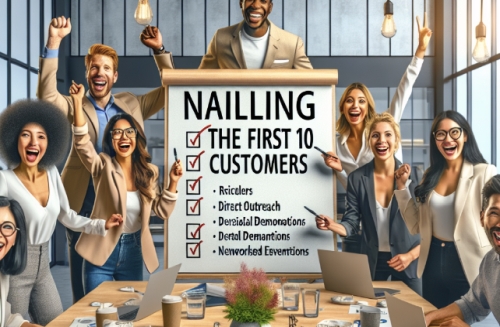
The first ten customers don’t arrive via scale tactics; they emerge from precise, high‑signal moves that remove uncertainty for real people with real deadlines. Treat this stage like building a bridge from zero to traction: every plank is a conversation, a commitment, or a micro‑event that tilts risk in your favor.
Most “scripts” fail because they’re monologues with punctuation. Human conversations are negotiated control: the buyer controls pace and context; you control structure and outcomes. The best scripts don’t tell reps what to say—they choreograph what must happen next.
Most objections are not rejections; they are unmade decisions. “Not now” usually means, “I can’t make a safe decision with the way this is being presented.” The fastest way to convert is not by arguing harder, but by redesigning the decision environment so timing feels safe.
Websites don’t win on cleverness; they win on certainty. Visitors arrive asking three questions, in order: Who are you? Is this for me? What happens next? The cool insight is that trust is a flow state: it emerges when your site reduces the effort required to answer those three questions and gives people control over what happens next. Everything that follows—design, persuasion, conversion—rides on that.
Most “personalization” dies under its own weight—too many variants, brittle tech, and copy that drifts off-message. The opportunity isn’t to build a page for every person; it’s to build one page that assembles the right few elements for each segment, automatically. The cool insight: 80% of the lift from “personalization” comes from swapping the first 60 words, the first proof, and the first path—hero, proof, and CTA—while leaving the rest of the page stable.
Most sites fail not for lack of features, but because they make visitors spend attention they didn’t budget. The cool insight: usability is a time exchange. Conversions rise when you minimize “decision time” and “interaction time” in the same flow. That means designing pages and paths that answer just enough, ask only what’s necessary, and make every next step the easiest one on the page.
Most content behaves like a sparkler: bright for a moment, then gone. Compounding content behaves like a dividend stock: it pays out, quarter after quarter, because it’s built to be reused, referenced, and routed into the next action. The cool insight: compounding isn’t about volume; it’s about architecture. When you design each asset to (1) stand alone, (2) ladder up to a bigger story, and (3) hand off to the next, your library gains yield over time.
In tight B2B niches, “thought leadership” is misnamed. It’s not about having thoughts; it’s about leadership. You win by setting the vocabulary, the metrics, and the calendar everyone else uses. The cool insight: you don’t need to be the loudest; you need to be the reference. Own the definitions, own the evidence, and own the moments when the market pays attention, and you’ll own the conversation.
Big budgets don’t win headlines; reliable insight and fast, low‑friction access do. The cool insight: in B2B, you can out‑punch larger rivals by becoming the market’s easiest, most credible source. That means three things done unusually well: comparable data, clear story architecture, and responsive access.
Most brands chase attention. The smarter ones create a place. A place is where your best-fit people come not just to consume, but to connect, trade knowledge, and return because it feels made for them. This is what a durable community does for a business: it turns a segment into a center of gravity.
The most underpriced growth lever in many businesses isn’t ads, features, or brand—it’s the designed experience of being your customer. Service isn’t a cost center; it’s how you compete when everyone else is racing to the bottom. When you architect service deliberately, you don’t just “fix problems faster”; you lower anxiety earlier, make next steps obvious, and turn operational competence into a signature that customers can feel.
Markets drift. Customer needs evolve without announcing themselves. The companies that stay relevant don’t guess better—they listen faster and close the loop tighter. Feedback loops are how you design that reflex: the habit of asking at the right time, in the right way, and responding with changes your customers can feel.
Loyalty isn’t an email offer or a punch card; it’s an engineered marketplace of motivations. The best programs deliberately blend three levers—rewards, referrals, and VIP access—so that customers feel recognized now, invested over time, and invited behind the rope. When these mechanics are tuned to the economics of your business and the psychology of your buyers, loyalty stops being a points spreadsheet and becomes a durable, compounding advantage.
In niche markets, the margin for analytical error is tiny. You don’t have the luxury of averaging away mistakes with sheer volume, so your metrics must privilege signal over scale. The goal isn’t more dashboards; it’s a smaller set of decision-grade measures that reliably predict cash contribution. Here’s a blueprint to track what actually matters—from the first glimmer of lead quality to a defensible LTV/CAC.
Seasonality isn’t just a demand problem; it’s an orchestration problem. The most resilient niche operators don’t “fight winter” or “milk summer.” They stack offsetting demand curves—across time, markets, and partners—so the aggregate looks more like a steady line than a roller coaster. Below is a practical playbook to smooth your curve without diluting your focus.
Most businesses overstay their welcome in a single niche, mistaking traction for invincibility. Others bolt into a second niche too early, convinced that “more” equals “safer,” and end up splitting their focus in half instead of compounding it. Portfolio thinking solves both problems: you move beyond “Should we expand?” to “What risk-return profile am I constructing, and when does a second niche meaningfully improve it?”
Most teams treat cross‑selling across segments as a copy‑paste job: reuse the pitch, slap on a new logo list, and ask sales to “go get it.” That’s how you lose deals you should win. Adjacent markets aren’t simply “more of the same.” They are familiar problems living inside different vocabularies, rituals, and constraints. The work is translation and choreography, not duplication.
Commodities are defined by easy substitution. Premium brands are defined by hard substitution. You don’t escape the commodity trap by adding features; you escape by changing the basis of comparison to something others can’t cheaply mimic—and making that difference legible. That’s where proof and packaging do the heavy lifting.
apartmentenvelopefile-emptybookcart